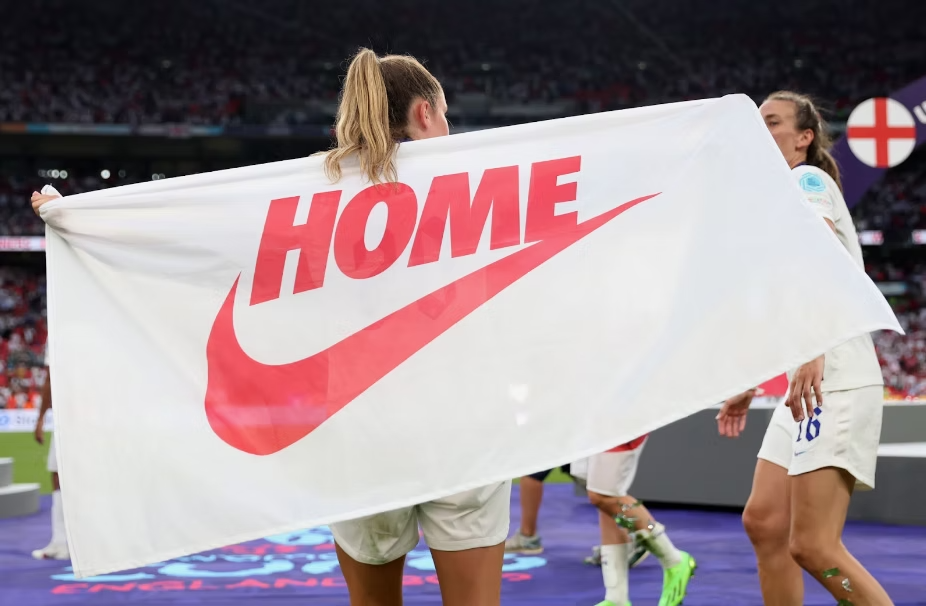
À l'occasion de la finale de l'Euro féminin, Nike a lancé une campagne audacieuse qui a immédiatement capté l'attention du public et suscité de vives réactions. Connue pour son célèbre logo "Swoosh", la marque a décidé de remplacer temporairement ce symbole iconique par un simple mot : "Home". Ce changement, bien que temporaire, a marqué un tournant dans la manière dont les marques peuvent s'engager dans des événements sportifs de grande envergure. Le mot "Home" est apparu sur des drapeaux dans le stade de Wembley, dans le métro de Londres, sur les réseaux sociaux de Nike Londres, spécialement créés pour l’occasion, et sur des t-shirts en édition limitée, qui ont été vendus en un temps record.
Une stratégie de rebranding audacieuse pour un moment historique
Ce changement de logo pour un événement sportif, aussi prestigieux que l'Euro féminin, est une décision audacieuse, surtout pour une marque aussi emblématique que Nike. Le "Swoosh" est l'un des logos les plus reconnaissables au monde, et l'idée de le remplacer, même temporairement, pour mettre en avant un message fort, démontre la volonté de Nike de s'impliquer profondément dans des événements qui comptent, au-delà du simple sponsoring traditionnel.
Le choix du mot "Home" est particulièrement symbolique. Il renvoie directement au célèbre chant anglais "Football's Coming Home", devenu un hymne non officiel du football en Angleterre. En utilisant ce terme, Nike a su capter l'esprit du moment, à savoir l'espoir et la fierté nationale entourant la compétition, surtout dans un contexte où le football féminin gagne en popularité et en reconnaissance.
Une campagne omnicanal : toucher les fans partout où ils sont
Nike a déployé cette campagne sur plusieurs canaux, créant ainsi un impact massif et cohérent. Au stade de Wembley, des drapeaux arborant le mot "Home" flottaient, marquant visuellement l'événement et ancrant cette nouvelle identité temporaire dans l'esprit des spectateurs. Dans le métro londonien, des affiches et des publicités ont pris le relais, s'assurant que les fans ne pouvaient pas échapper à ce message. Sur les réseaux sociaux, Nike Londres a mis en place des comptes dédiés pour amplifier la portée de la campagne, en engageant directement avec les fans et en partageant des contenus en lien avec la finale de l'Euro féminin.
L'approche omnicanal de Nike a permis de toucher un public large et diversifié, allant des fans présents physiquement à Wembley à ceux qui suivent l'événement en ligne. Cette stratégie a non seulement renforcé la visibilité de la campagne, mais elle a aussi permis à Nike de créer un véritable mouvement autour de l'événement, renforçant ainsi l'engagement des supporters.
Le rôle des t-shirts en édition limitée : créer de la rareté et de la désirabilité
En plus des éléments visuels et numériques, Nike a lancé des t-shirts en édition limitée portant le mot "Home", qui se sont vendus en quelques heures. Cette initiative montre une compréhension fine de la psychologie des consommateurs. En créant un produit limité en quantité, Nike a su générer un sentiment d'urgence et de désirabilité parmi les fans. Les t-shirts sont devenus plus qu'un simple vêtement, ils sont devenus des objets de collection, symbolisant l'attachement à cet événement historique.
Le succès de cette vente rapide démontre l'efficacité de Nike à exploiter la rareté comme levier marketing. Les consommateurs ne se contentent pas d'acheter un produit, ils achètent une part de l'histoire, une manière de montrer leur soutien à l'équipe nationale féminine de football et de s'aligner avec les valeurs véhiculées par la marque.
Un message fort : célébrer le football féminin et l'inclusivité
Au-delà de l'aspect commercial, cette campagne est également un hommage au football féminin, qui a longtemps été sous-estimé par rapport à son pendant masculin. En choisissant de centrer sa campagne sur un événement féminin, Nike envoie un message clair sur l'importance et la reconnaissance du sport féminin. La marque se positionne comme un acteur clé dans la promotion de l'égalité des sexes dans le sport, un enjeu de plus en plus central dans les discussions sociétales.
Le mot "Home" résonne également avec les valeurs d'inclusivité et de communauté. Il symbolise l'idée que le football appartient à tous, indépendamment du genre, et que les exploits des femmes sur le terrain méritent tout autant d'être célébrés que ceux des hommes. Cette campagne s’inscrit donc dans une démarche plus large de Nike, visant à promouvoir la diversité et l’inclusion dans toutes ses communications.
Une leçon pour les autres marques : oser l'innovation dans le branding
Ce que Nike a fait avec cette campagne est une leçon de marketing pour d'autres grandes marques. L'idée de toucher à un élément aussi fondamental qu'un logo pour une occasion spéciale montre qu'il est possible de prendre des risques calculés pour créer un impact mémorable. En osant temporairement remplacer son logo mondialement reconnu, Nike a non seulement renforcé son lien avec les fans, mais a également démontré sa capacité à innover et à se réinventer sans compromettre son identité de marque.
Cette campagne est un exemple parfait de la manière dont une marque peut utiliser un événement sportif pour renforcer son image et son engagement auprès de ses consommateurs. En capitalisant sur un moment historique, Nike a su créer une campagne qui non seulement célèbre l'événement, mais qui restera dans les mémoires comme une étape importante dans la reconnaissance du football féminin.
En conclusion, Nike, avec son initiative "Home" pour l'Euro féminin, n'a pas seulement célébré un événement sportif, mais a aussi marqué un grand coup dans l'histoire du marketing sportif. Cette campagne est un exemple de la manière dont une marque peut utiliser un événement pour réaffirmer ses valeurs, renforcer son engagement et, finalement, se rapprocher encore plus de sa communauté. Si cette initiative est un indicateur de ce que Nike réserve pour l'avenir, il est clair que la marque continuera à repousser les limites du marketing et à inspirer d'autres à faire de même.